

Foundry Tech: Materials Properties
Before we start delving into each of the material groups, we need to understand material properties. Some material properties, such as tensile strength and hardness are directly measurable, whereas toughness is not so easily defined.
Following are some property terms that will be used throughout this series:
Yield (Proof) Strength
Yield strength is the point at which the material changes from elastic deformation to plastic deformation. Imagine a rod being pulled apart at each end. As the stress increases, the rod will start to stretch. Up to a certain stress it will return to its original length when the stress is removed, i.e. it behaves elastically. Once past that certain stress, it will begin to yield and will behave plastically, i.e. it will stay stretched when the stress is removed.
This is an especially important engineering property, as the design engineer uses this figure to calculate the factor of safety. If the material is stressed past its yield strength, the casting will permanently deform.
Some materials have well defined yield strengths. Others have less defined points of yield, so a calculation is performed to give an offset or proof strength.
Yield strength is measured using a test bar machined to a standard size that is destructively tested in a tensile tester and is normally expressed in megapascals (MPa).
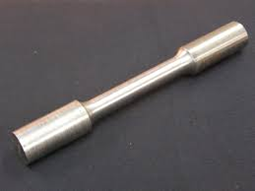 Test bar |
 Tensile tester |
Ultimate Tensile Strength
Imagining the same rod, and we’ve applied enough stress to make it stretch permanently. If we keep stretching, it will eventually break. The stress at which it breaks is the ultimate tensile strength. This is normally expressed in MPa and is measured in the same tensile test as the yield strength.
Elongation
As the name implies, this measures the amount of stretch from original length to the length at failure and is expressed as the percentage of stretch against the original length. This is the last measurement out of the tensile test.
Hardness
Hardness is the resistance to local deformation from a point load. There are several tests that can be done, the most well-known being Rockwell and Brinell. Both involve loading an indenter of known geometry with a known load. Rockwell uses a diamond “braille” or cone and measures the depth of penetration. The harder the material, the less penetration and the higher the Rockwell number. This test is more suited to machined surfaces, such as shafts etc. The Brinell test uses a 10mm diameter tungsten carbide ball, loaded with 3,000kg of force. The ball presses into the material, with less penetration indicating a harder material. The diameter of the impression is measured and the Brinell hardness calculated. This test is better suited to the casting application, as it tests a larger area to give a more representative indication of the hardness.
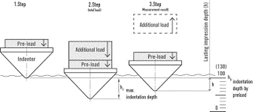 Rockwell Hardness Test |
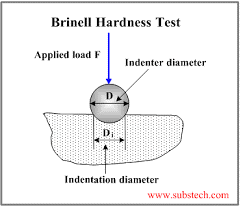 Brinell Hardness Test |
Impact Properties
Standard test pieces are machined with notches are tested in a pendulum impact tester, which measures the amount of energy it takes to break the test pieces. This is measured in joules (J). The amount of energy it takes to break is high if the material is “tough” or “ductile”, and is low if the material is brittle. Toughness can reduce as the temperature drops, this is particularly important for materials used in sub-zero applications.
The above properties are measurable, and the limits are defined in the material standards.

Import tester and sample
It’s important to understand that a balance needs to be found for the required material properties. If a hard material is required for wear resistance, the yield and tensile strength will be up, and elongation and impact will be down, indicating it is becoming more brittle. If better impact properties are required then hardness, yield and tensile will be lower.