

Foundry Tech: Grey Iron
Grey iron, also known as cast iron, has been produced for more than 2,000 years.
It remains one of the most widely used casting materials due to its low cost and ease of production. While it has been surpassed by higher-strength alloys in many applications, grey iron continues to play an important role as a reliable and versatile engineering material.
Grey iron is essentially an alloy of iron (Fe) and carbon (C). The carbon is present in the form of microscopic graphite flakes that create a three-dimensional network throughout the metal.
To visualize this structure, imagine a handful of cornflakes, this is similar to the flake pattern shown in Photo 1, where the metal has been etched away. Photo 2 shows the structure of a typical grey iron sample: the black lines represent graphite flakes, and the grey areas are pearlite, a crystalline form of iron that provides strength and hardness.
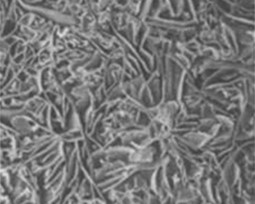 Graphite flakes at 100× magnification |
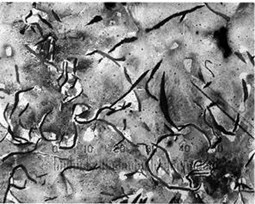 Grey iron at 200× magnification |
While the graphite flakes reduce the overall strength and make the iron more brittle, they also provide several important benefits.
The flake structure helps absorb vibration, which is why grey iron is commonly used in machining beds, pump bearing housings, and other components where vibration damping is essential.
In addition, graphite has high thermal conductivity — the ability to transmit and dissipate heat efficiently. This makes grey iron ideal for brake drums and brake rotors in cars and trucks, where rapid heat removal during braking is critical.
From an engineering standpoint, grey iron has no yield point or elongation, meaning it cannot plastically deform before failure. Despite this, it remains a simple and effective alloy to cast due to its excellent fluidity, allowing it to reproduce fine surface details from the mould.